

Capital market volatility is a critical factor in the financial lives of retirees and near-retirees.
Volatility plays a major role in the pricing of many different types of annuities, and volatility is the major driver of sequence of returns risk.
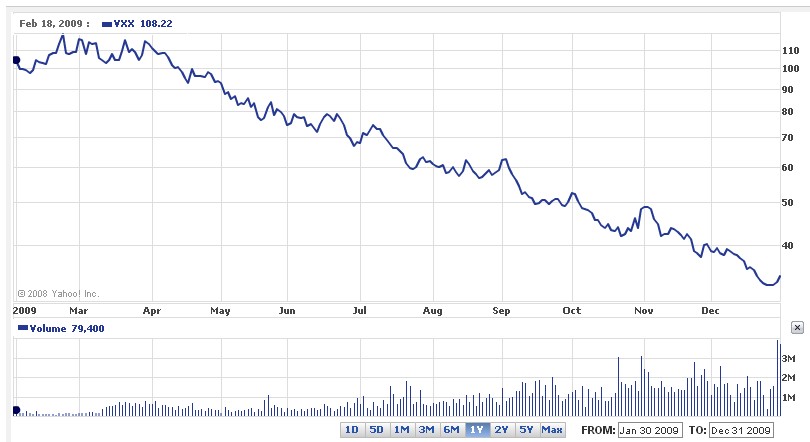
2009 was a year of extremes in terms of volatility. Consider, for example, an exchange traded fund (VXX) that seeks to replicate the CBOE volatility index (VIX). This ETF hit a high of 119 in February of 2009 and then went as low as 32 in December 2009—a decrease of 73%.
For retirees, it may be wise to assume that recent tranquility will be fleeting.
Financial author Marc Faber made some interesting points in this regard during a presentation at the 2009 Financial Analysts Seminar in Chicago.
Faber points out that confusion and volatility will persist as a result of the contradiction between private sector credit conditions and the Fed’s efforts to flood the system with liquidity. Faber believes that annual swings of plus or minus 30 percent in the S&P can be expected in the near-term.
One way to address this possibility is through long positions in volatility-related instruments such as VXX.
Retirees and near-retirees should also be aware that:
- High levels of volatility can result in sequence of returns risk.
- Sequence of returns risk decreases the ability of a portfolio to produce sustainable income throughout retirement.
- Sequence of returns risk also leads to an increase in longevity risk.
- Higher volatility increases hedging costs for insurers and makes certain annuities more expensive.
- tom's blog
- Log in to post comments


Comments
Anonymous replied on Permalink
Volatility and annuity prices
why would higher volatility have any impact on current annuity prices?
tom replied on Permalink
Volatility and annuity prices
Insurance companies use derivatives extensively in the annuity "manufacturing" process.
Similar to interest rates, volatility is a key component of derivative prices.
There is a direct relationship between volatility and derivative pricing, so higher volatility = higher derivative costs.
In a sense, higher volatility increases the cost of manufacturing an annuity and these higher costs are ultimately passed along to the end consumer in the form of higher annuity prices.